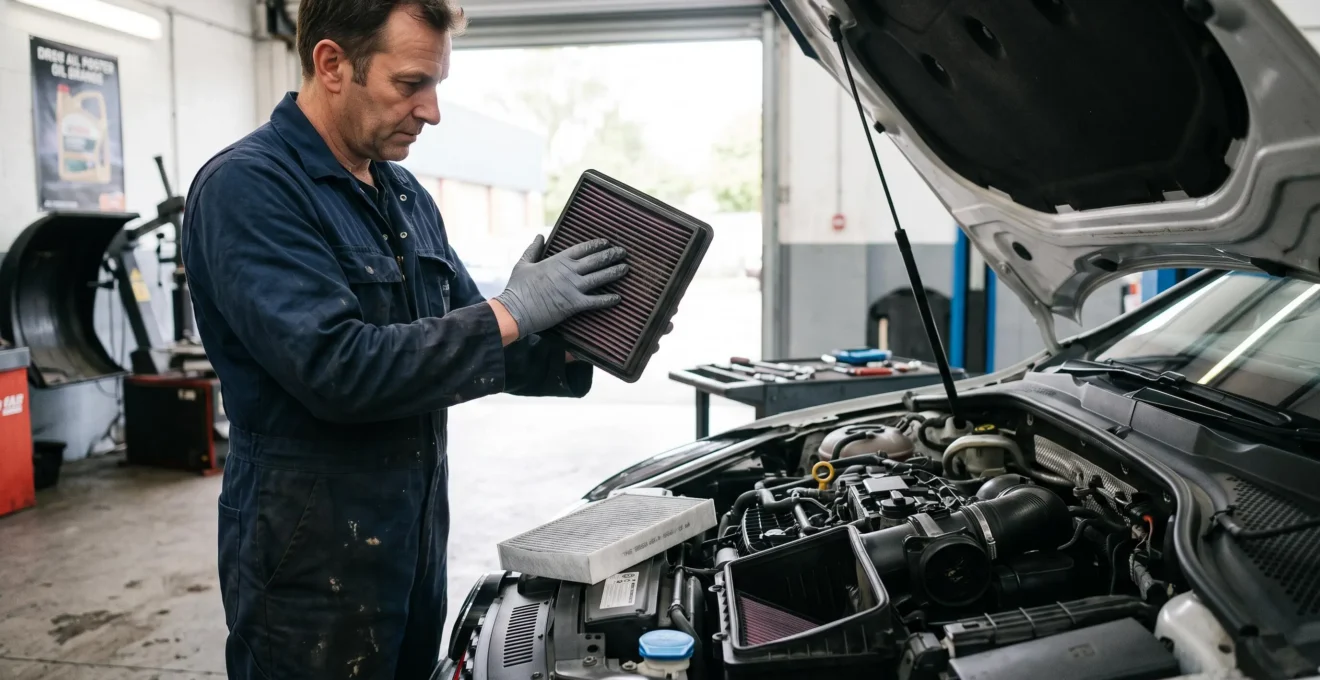
High-performance air filters can improve engine performance, but only when the original intake system creates enough restriction for additional airflow to make a measurable difference. On a standard, properly maintained road car, replacing a clean factory filter with a high-flow alternative often produces little or no detectable horsepower gain.
The distinction lies between an air filter’s ability to flow more air and the engine’s actual demand for that air. An aftermarket filter may offer lower resistance under controlled testing without increasing the amount of air the engine consumes during normal driving. Engine speed, load, valve timing, intake design and electronic calibration all influence the outcome.
That does not make performance filters pointless. Reusable media, reduced restriction at higher airflow demand and compatibility with other engine upgrades can justify the investment. However, filtration efficiency, intake temperature, maintenance requirements and emissions compliance matter just as much as advertised airflow capacity.
Understanding where the filter fits within the complete intake and exhaust system is the most reliable way to decide whether an upgrade is worthwhile.
High-performance air filters: the essentials
- Power gains are conditional: A high-flow filter helps only when intake restriction is limiting the engine’s ability to ingest air.
- Filtration and temperature matter: A well-sealed panel filter can be preferable to an exposed cone intake, particularly in hot or dusty environments.
- Supporting upgrades change the calculation: Intake improvements become more relevant when engine modifications increase airflow demand and appropriate calibration supports them.
- Why Can a High-Flow Air Filter Make Little Difference on a Standard Engine?
- How Should You Clean and Maintain a Reusable Performance Air Filter?
- Performance Panel Filter or Open Intake: Which Better Suits a Daily Driver?
- What Can Go Wrong With an Incorrectly Maintained Performance Air Filter?
- When Does a High-Performance Air Filter Become Worthwhile?
- How Can You Size a Sport Exhaust for a Road Car Without Going Too Large?
- ECU Remap or Hardware Upgrades: Which Should Come First for More Power?
- How Can You Improve Your Car’s Power Without Sacrificing Reliability?
Why Can a High-Flow Air Filter Make Little Difference on a Standard Engine?
A high-flow air filter often makes little difference on a standard engine because the factory intake already supplies sufficient air for its original power output. Reducing filter resistance cannot produce significant additional power unless that resistance was limiting airflow. The result depends on engine demand, the complete intake system and operating conditions, not filter flow capacity alone.
Air reaches the cylinders through a series of components: the filter, intake ducting, mass airflow sensor housing where fitted, throttle body, intake manifold runners and intake valves. Valve timing, camshaft profiles and engine speed determine how efficiently the cylinders fill. On turbocharged engines, compressor operation and boost control introduce further constraints.
Replacing one component with a less restrictive alternative does not eliminate limitations elsewhere. Likewise, a standard ECU calibration may maintain its existing torque or boost targets rather than use additional available airflow to produce more power.
The critical distinction is between airflow capacity and airflow demand. A filter capable of passing more air under test conditions does not necessarily increase flow through an engine that is already receiving sufficient air.
A useful diagnostic question is whether the original filter causes excessive pressure drop at maximum engine demand. If the clean factory filter remains comfortably within the manufacturer’s intake restriction limits, installing a higher-flow element offers little reason to expect substantial power gains.
Real-world research: What happens when intake restriction increases?
Oak Ridge National Laboratory tested three modern fuel-injected gasoline vehicles using new and deliberately restricted air filters. The researchers measured acceleration performance and fuel economy under specified test conditions.
In the 20–80 mph wide-open-throttle test, the Toyota Camry’s acceleration time increased from 17.24 to 18.51 seconds with the simulated clogged filter. The Buick Lucerne increased from 13.77 to 15.45 seconds, while the Dodge Charger’s time rose from 10.23 to 10.84 seconds.
These results demonstrate that severe intake restriction can reduce acceleration performance. They do not establish that replacing a clean OEM filter with a performance filter delivers comparable gains. The three modern vehicles also showed no statistically significant fuel economy differences over the driving cycles examined.
The experimental methods and limitations are documented in Oak Ridge National Laboratory’s air filter condition study.
This distinction helps explain why drivers sometimes report sharper throttle response without corresponding measurable power improvements. A louder intake makes engine acceleration more noticeable, while minor throttle or airflow changes may not translate into repeatable horsepower differences.
Chassis dynamometer results also require careful interpretation. Engine temperature, tyre conditions, test procedure and measurement repeatability can affect comparisons. A small difference between runs is not automatically evidence of an effective modification.
Restriction deserves closer attention when an existing filter is severely contaminated or when the engine operates at sustained high load. Towing, altitude and hot operating environments can change engine operating demands, but they do not independently guarantee that an aftermarket filter will improve power.
For most standard engines, ensuring that the original intake is clean, properly sealed and functioning within specification is more valuable than assuming greater filter capacity automatically produces more horsepower. That makes maintenance the next essential consideration.
How Should You Clean and Maintain a Reusable Performance Air Filter?
A reusable performance air filter should be inspected, cleaned with products compatible with its specific media, dried completely and re-oiled only when its design requires oil. Maintenance intervals depend on the manufacturer, driving environment and accumulated contamination. Incorrect cleaning or oil application can compromise filtration, restrict airflow or introduce contaminants into sensitive intake components.
Most reusable automotive performance filters fall into two broad media categories: oiled cotton or gauze and dry synthetic media. Their maintenance requirements are not interchangeable. Oiled designs rely on a specified oil treatment, while dry filters are engineered to operate without it.
Manufacturer instructions take priority over generic cleaning advice. For example, aFe POWER‘s filter maintenance instructions differentiate oiled and oil-free product families and specify compatible maintenance products. Those instructions apply to the manufacturer’s designated filters, rather than establishing one universal cleaning procedure.
A practical maintenance sequence is:
- Inspect the installation. Check the filter housing, seals, clamps and media for damage. Confirm that the filter is designed to be serviced rather than replaced.
- Remove loose debris carefully. Follow the manufacturer’s approved method and avoid aggressive brushing, compressed air or other techniques that could damage the media.
- Wash using the correct process. Apply the approved cleaner and water only where permitted. Avoid household detergents, solvents or excessive pressure unless specifically authorized.
- Allow complete drying. Follow the filter manufacturer’s drying instructions. Do not reinstall a wet filter or use damaging heat to accelerate drying.
- Re-oil when required. Apply the specified type and quantity of filter oil to compatible media, allow the treatment to distribute as instructed and remove excessive oil according to the product procedure.
Inspection frequency should reflect exposure rather than an arbitrary mileage figure. A vehicle driven regularly on dusty rural roads may require earlier checks than one used on clean, paved routes. However, visible dirt alone does not establish that a filter has reached its restriction limit.
Where suitable equipment is available, measuring intake pressure drop under the specified operating conditions provides stronger evidence of restriction. Readings must be interpreted against the engine and filter manufacturer’s criteria. A simple visual check cannot reliably quantify either airflow restriction or particle-capture efficiency.
Pay particular attention to filters installed upstream of a mass airflow sensor. Excess oil can potentially contaminate sensitive components, depending on the design and circumstances. If rough idling, abnormal fuel trims or relevant diagnostic fault codes appear after servicing, inspect the filter installation and investigate the intake measurement system rather than assuming the filter is harmless.
Properly maintained reusable filters can remain useful over repeated service cycles, but their convenience must be weighed against the attention they require. That burden becomes especially relevant when choosing between a factory-style panel filter and an exposed intake.
Performance Panel Filter or Open Intake: Which Better Suits a Daily Driver?
A performance panel filter is usually the more practical choice for a standard or lightly modified daily driver because it retains the factory airbox, intake routing and protection from engine-bay heat. An open intake may offer greater sound and airflow potential, but its effectiveness depends on thermal shielding, filtration quality and the engine’s actual airflow requirements.
A drop-in performance panel filter typically fits inside the original airbox. This preserves the vehicle’s engineered intake location and limits installation complexity. By contrast, an open-cone system replaces or rearranges part of the original intake assembly, potentially changing airflow characteristics, intake noise and exposure to surrounding temperatures.
The most important trade-off is that lower restriction does not automatically mean greater air density. An exposed cone positioned near hot engine components may ingest warmer air than a sealed factory intake. Warmer intake air is less dense at the same pressure, potentially reducing the mass of oxygen reaching the cylinders.
Shielded and properly engineered cold-air intake systems attempt to address this problem by controlling where intake air originates. However, their results remain vehicle-specific and should be assessed under realistic operating conditions.
The comparison below focuses on everyday ownership rather than advertised peak-flow figures.
| Decision criterion | Performance panel filter | Open intake or cone system |
|---|---|---|
| Intake air temperature | Usually retains factory airbox temperature management | Depends heavily on placement, shielding and fresh-air supply |
| Filtration efficiency | Depends on media specification and sealing | Depends on media specification, sealing and installation quality |
| Heat-soak exposure | Generally lower with a properly sealed factory airbox | Potentially higher when exposed to engine-bay air |
| Intake noise | Usually close to original levels | Often noticeably louder under acceleration |
| Purchase and installation cost | Typically lower, with simpler installation | Typically higher for a complete engineered system |
| Maintenance exposure | Protected within the original housing | May need more frequent inspection depending on placement |
| Emissions compliance | Vehicle and part-specific requirements still apply | Greater modification scope may require additional compliance checks |
| Reversibility | Usually straightforward | Depends on whether factory components are retained or altered |
The maintenance difference deserves particular attention. An exposed filter positioned near areas of higher dust, splash or road-debris exposure may require additional inspection. A sealed panel filter benefits from the factory housing’s protection, although it still requires servicing according to its specific media and operating environment.
For a stock commuter used in hot weather or dusty conditions, retaining a sealed airbox is generally a sensible starting point. A modified vehicle with demonstrated intake restriction may justify a complete, well-engineered intake system, particularly when independent or properly controlled vehicle-specific testing shows an improvement.
The best comparison measures performance with representative engine-bay temperatures, consistent operating conditions and the correct ECU calibration. Intake noise alone is not sufficient evidence of increased power.
An intake that preserves air density and reliable filtration may outperform a more visually dramatic solution in practical use. Whichever design is selected, poor maintenance can turn a modest performance upgrade into an engine-protection problem.
What Can Go Wrong With an Incorrectly Maintained Performance Air Filter?
Incorrectly maintained performance air filters can allow abrasive particles into the engine, increase intake restriction, contaminate sensors or lose their seal. Torn media, unsuitable cleaning products and incorrect oil application are important risks. The consequences can extend beyond reduced power to engine wear, diagnostic faults and potentially expensive repairs.
Every intake filter must balance airflow resistance with particle capture. A filter that offers high flow but allows excessive fine dust through the media can expose internal engine components to abrasive contamination. This is particularly concerning for cylinders, piston rings and turbocharger compressor components.
Unlike a small horsepower difference, cumulative engine wear may not produce obvious symptoms immediately. Filtration performance should therefore be assessed using appropriate, comparable efficiency data rather than airflow claims alone.
Several failure modes deserve attention:
- Damaged media: Tears, collapsed pleats or degraded material may create pathways for unfiltered air.
- Failed sealing: A displaced element, damaged gasket or poorly tightened clamp can allow contaminants to bypass the filter.
- Incorrect oil treatment: Excess oil may contribute to sensor contamination, while insufficient treatment of media designed for oil can compromise intended filtration performance.
- Unsuitable cleaning: Harsh chemicals or excessive physical force can weaken or distort filter material.
- Delayed servicing: Excessive contamination can increase restriction and reduce available airflow under demanding conditions.
Laboratory research has demonstrated that extreme restriction can also create mechanical problems. During Oak Ridge National Laboratory’s deliberately restricted-filter testing, the Dodge Charger’s air filter became displaced, distorted and torn. That was an experimental severe-restriction condition, not evidence that properly maintained performance filters normally fail this way.
Inspection should include the clean side of the airbox, filter gasket, fastening points and any visible gaps. For oiled media, compare the oil coverage with the manufacturer’s servicing guidance rather than relying on an improvised oil quantity or appearance test.
If drivability deteriorates after maintenance, a diagnostic scan can help identify relevant fault codes or abnormal sensor behavior. However, codes alone cannot establish that a contaminated filter caused a fault. Further inspection and testing may be required.
Warranty and legal considerations are separate from mechanical reliability. Coverage depends on applicable consumer law, warranty terms and the relationship between a modification and the claimed failure. Road-use legality likewise varies across English-speaking jurisdictions and by the exact part installed.
These risks reinforce the importance of evaluating a performance filter as an engineering component rather than a simple power accessory. Its benefits become more convincing only when they address a real restriction or an identifiable ownership need.
When Does a High-Performance Air Filter Become Worthwhile?
A high-performance air filter becomes worthwhile when the original filter is a demonstrated airflow restriction, when supporting engine modifications increase air demand, or when reusable construction offers meaningful long-term ownership value. It is less compelling as a standalone horsepower upgrade on a well-maintained standard engine with sufficient factory intake capacity.
The decision should begin with the reason for buying one. A driver prioritising reusable media and convenient servicing may reach a different conclusion from someone seeking a measurable reduction in acceleration time.
For a performance-focused purchase, verify the restriction before buying the solution. Measure intake pressure drop where suitable instrumentation and manufacturer specifications are available, or seek credible testing on the same vehicle and engine configuration.
Filter condition matters when interpreting those results. A comparison between a heavily contaminated factory filter and a new aftermarket product demonstrates the effect of restoring airflow, but does not isolate the benefit of performance-filter design.
Donaldson’s filtration guidance explains why servicing decisions are better informed by actual intake restriction than appearance alone. Its technical article on air filter servicing also discusses the contamination risks associated with unnecessary maintenance. The guidance spans different engine and equipment applications, so passenger-car owners must still follow their vehicle manufacturer’s service requirements.
A reusable filter may offer ownership savings when it remains serviceable through repeated cleaning cycles. However, the purchase price, approved cleaning products, servicing time and potential replacement requirements all affect the calculation. No universal savings figure applies to every driver.
The performance argument strengthens when modifications change the engine’s breathing requirements. A suitable intake filter can support increased airflow demand created by changes to the turbocharger, intake system, engine calibration or other components. Even then, its contribution must be assessed as part of the complete setup.
Five checks before buying a performance air filter
- Document the existing filter’s condition. Record its part number, service history and any visible damage; keep a dated inspection note.
- Identify the engine’s actual airflow limitation. Obtain applicable manufacturer restriction specifications and available test results; write down whether restriction has been demonstrated.
- Compare compatible filter designs. Check fitment, filtration information, media type and installation requirements; produce a shortlist of suitable products.
- Calculate the ownership implications. Record purchase cost, approved maintenance supplies and expected service requirements; prepare a simple cost comparison with OEM replacements.
- Verify installation constraints. Check emissions requirements, warranty implications and any calibration needs; retain the relevant documentation before purchasing.
For a standard vehicle still under warranty, particularly one operating in dusty conditions, a quality OEM filter replaced according to the manufacturer’s requirements may remain the better financial and engineering choice.
When the filter is no longer the main constraint, further power gains may depend on other parts of the breathing system. Exhaust sizing is a useful example of why changing airflow capacity requires a coordinated approach.
How Can You Size a Sport Exhaust for a Road Car Without Going Too Large?
A sport exhaust should be sized around the engine’s intended power output, operating RPM range and exhaust flow requirements, rather than the largest diameter available. An unnecessarily oversized system may compromise gas velocity and exhaust tuning, particularly on naturally aspirated engines. The best road-car configuration balances performance, sound, emissions compliance and everyday drivability.
Exhaust sizing involves more than reducing backpressure. Pipe diameter influences gas velocity and the pressure-wave behaviour that contributes to cylinder scavenging. On naturally aspirated engines, correctly timed pressure waves can help the engine clear exhaust gases and improve cylinder filling.
An excessively large exhaust may weaken useful gas velocity and pressure-wave tuning in parts of the operating range, potentially reducing low- and mid-range torque. However, larger pipes do not inherently reduce engine power simply because exhaust gases move more slowly. The result depends on the complete exhaust geometry, engine design and operating conditions.
Turbocharged engines introduce another consideration: the turbine changes exhaust pressure and energy requirements. Reducing restrictive post-turbine exhaust components may be beneficial, but the appropriate diameter still depends on the engine’s power target, emissions equipment and vehicle packaging.
A practical sizing process starts with three questions:
- What power level and torque characteristics are realistically required?
- At which engine speeds will the car spend most of its operating time?
- Does a reputable manufacturer provide engine-specific flow, fitment and performance information for the proposed system?
These answers help establish a suitable configuration without copying a motorsport exhaust designed for a different engine and operating range. Diameter alone cannot provide a reliable universal sizing rule.
Supporting components deserve equal consideration. Muffler design affects sound attenuation, while resonators help manage unwanted frequencies. Highway exhaust drone is a particularly important comfort issue for daily drivers because it can remain noticeable during sustained cruising.
Catalytic converters and other emissions-control components must remain compliant with the rules applicable to the vehicle and jurisdiction. A sport exhaust that delivers desirable sound or flow but compromises road legality is not necessarily a practical upgrade.
Intake and exhaust decisions also interact. Lower intake restriction may be of limited benefit when other airflow constraints remain, just as a less restrictive exhaust may yield little improvement if the engine cannot exploit it. Engine calibration can affect how the complete combination performs.
A matched exhaust should support the engine’s intended operating range without sacrificing acceptable noise levels or legal compliance. Once the mechanical restrictions are understood, ECU calibration becomes the next decision.
ECU Remap or Hardware Upgrades: Which Should Come First for More Power?
An ECU remap can be the first effective performance upgrade when the existing engine hardware has sufficient capacity and the calibration can safely use it. Hardware should come first when the desired power level exceeds mechanical or thermal limits. The correct sequence depends strongly on whether the engine is turbocharged or naturally aspirated, and both approaches require appropriate validation.
Modern engine management controls parameters including ignition timing, fueling, throttle operation and, where applicable, turbocharger boost. Recalibration can change how the engine uses its existing components, but it cannot eliminate fundamental mechanical restrictions or safely bypass all factory protection limits.
Turbocharged engines often offer greater calibration-only potential than naturally aspirated engines because boost targets and torque-management strategies can influence delivered power. The available headroom still varies considerably between engines, and it must be assessed against fuel quality, temperature, turbocharger capacity and component durability.
Naturally aspirated engines typically have less calibration-only scope because airflow depends more directly on displacement, volumetric efficiency and mechanical breathing characteristics. Intake, exhaust, camshaft or other hardware changes may therefore play a larger role in achieving substantial increases.
The objective is not to choose an ECU remap or hardware in isolation. It is to match calibration to the installed components and the intended use.
For example, a modestly modified turbocharged road car might benefit from an appropriate calibration before more extensive hardware changes. Conversely, an engine targeting significantly higher output may require upgraded cooling, fuel delivery or turbocharger hardware before its new calibration is finalised.
Installing significant airflow-related modifications without appropriate calibration can create compatibility or control problems, depending on the engine management strategy. Fueling errors, knock control activity, abnormal boost behavior or excessive temperatures are potential concerns. Some factory systems can compensate for limited changes, but their adaptive capabilities should not be treated as unlimited.
Validation should include relevant diagnostic data, controlled performance testing and checks under the loads the vehicle will actually experience.
Regulatory requirements are equally important. The California Air Resources Board‘s aftermarket parts program explains the Executive Order exemption process for qualifying emissions-related modifications and vehicle applications. This is a California-specific framework, not a universal rule for every aftermarket filter or remap.
Drivers in the United Kingdom, Canada, Australia, New Zealand and other jurisdictions should check their applicable roadworthiness, emissions, insurance and warranty requirements separately. An approval in one market does not automatically establish legality elsewhere.
A well-matched tune can help an appropriate hardware package operate as intended, but neither should be evaluated without considering engine durability. Sustainable performance requires the supporting systems to remain within their safe operating limits.
Key takeaways before increasing engine power
- Establish the engine’s mechanical condition, service history and thermal performance before asking it to produce more power.
- Treat intake, exhaust and calibration changes as one interacting system, with measurable objectives and documented limits.
- Reserve sufficient capacity for cooling, fuel delivery, transmission durability and braking performance rather than focusing exclusively on peak horsepower.
How Can You Improve Your Car’s Power Without Sacrificing Reliability?
Improving engine power without unnecessarily compromising reliability requires a healthy mechanical baseline, compatible modifications, conservative calibration and monitoring under real driving conditions. Start by confirming that the engine, cooling system and maintenance items are functioning correctly. Increase performance only within the capabilities of the components that support it.
The most reliable upgrade strategy resembles a pyramid: every additional performance demand must be supported by the systems underneath it. A stronger engine output figure is of limited value if cooling, fuel delivery or transmission capacity cannot sustain it.
The foundation is maintenance. Before considering a performance air filter or ECU remap, inspect the engine for existing faults and ensure that appropriate fluids, ignition components, belts, hoses and other service items meet the manufacturer’s specifications.
The next level consists of modest breathing upgrades. A properly sealed intake and correctly sized exhaust may reduce genuine restrictions, but both should be selected for the engine’s actual requirements. A filter that passes additional air while compromising particle capture is not a reliability-focused improvement.
Calibration follows the same principle. A carefully validated ECU remap should respect appropriate fuel, ignition, boost and thermal limits. More aggressive targets can increase mechanical and heat loads, even when the engine initially appears to perform well.
Higher-output modifications, including larger turbochargers or forced induction added to naturally aspirated engines, increase the importance of supporting hardware. Fuel system capacity, charge-air cooling, engine cooling, transmission durability, clutch capacity and braking performance may all need reassessment.
Regular monitoring helps identify problems before they escalate. Useful diagnostic parameters can include:
- Coolant and engine oil temperatures: Look for abnormal increases during sustained load and compare values with appropriate vehicle specifications.
- Fuel trims and air-fuel behaviour: Investigate persistent corrections or unexpected deviations using the correct operating context.
- Ignition correction and knock activity: Look for patterns suggesting that combustion conditions require attention.
- Boost pressure and control behaviour: On turbocharged engines, compare actual operation with the intended calibration targets.
- Diagnostic trouble codes: Investigate recurring faults rather than simply clearing them.
These measurements require competent interpretation. A single reading rarely proves that an engine is safe or unsafe, and not every vehicle exposes the same parameters. Appropriate professional testing is valuable when modifications significantly change operating conditions.
Reliability also depends on how the vehicle is used. Repeated high-load acceleration, sustained hot-weather operation and demanding track use place different stresses on components than ordinary commuting. An upgrade suitable for occasional road use may need further validation for sustained performance driving.
Ultimately, the value of a performance air filter comes from its contribution to a properly balanced system. It may reduce a genuine airflow restriction, facilitate future modifications or offer reusable construction. It cannot substitute for correct exhaust sizing, suitable calibration or adequate component protection.
Begin with a service inspection and a clearly defined performance objective. Establish whether the factory intake is actually restricting the engine, then evaluate intake, exhaust and calibration changes together. Prioritise verified improvements in usable performance while preserving filtration quality, legal compliance and sufficient mechanical safety margins.
Can a high-performance air filter improve fuel economy?
Lower intake restriction does not automatically improve fuel economy. Engine management, driving conditions and load determine the result. Oak Ridge National Laboratory’s research found no statistically significant fuel economy changes from deliberately restricted filters in the three modern fuel-injected vehicles tested over the specified driving cycles. This does not establish a fuel-saving advantage for aftermarket performance filters.
Does a performance air filter require an ECU remap?
A compatible drop-in performance panel filter generally does not require an ECU remap on a standard engine. However, significant intake hardware changes may affect airflow measurement or engine calibration requirements. Verify the manufacturer’s installation instructions and assess vehicle-specific compatibility before modifying the intake system.
Can an aftermarket air filter damage a turbocharger?
An aftermarket filter is not inherently harmful to a turbocharger. Risk increases when damaged media, inadequate filtration or poor sealing allows abrasive particles to enter the compressor inlet. Correct fitment, suitable filtration performance and proper maintenance matter more than whether the filter is marketed as standard or high-performance.
Is a washable air filter always cheaper than replacing paper filters?
Not necessarily. Reusable filters can reduce the number of replacement elements purchased, but cleaning supplies, servicing effort, filter lifespan and initial price all affect ownership costs. Compare the total expected maintenance expense over your intended ownership period rather than assuming reusability guarantees savings.
Can a dirty factory air filter cause a noticeable loss of acceleration?
Yes, severe restriction can reduce available airflow during high-load operation and affect acceleration. Experimental testing by Oak Ridge National Laboratory demonstrated this effect using deliberately restricted filters. Ordinary dust accumulation does not necessarily produce the same result, so filter condition and intake restriction should be assessed against the applicable service criteria.