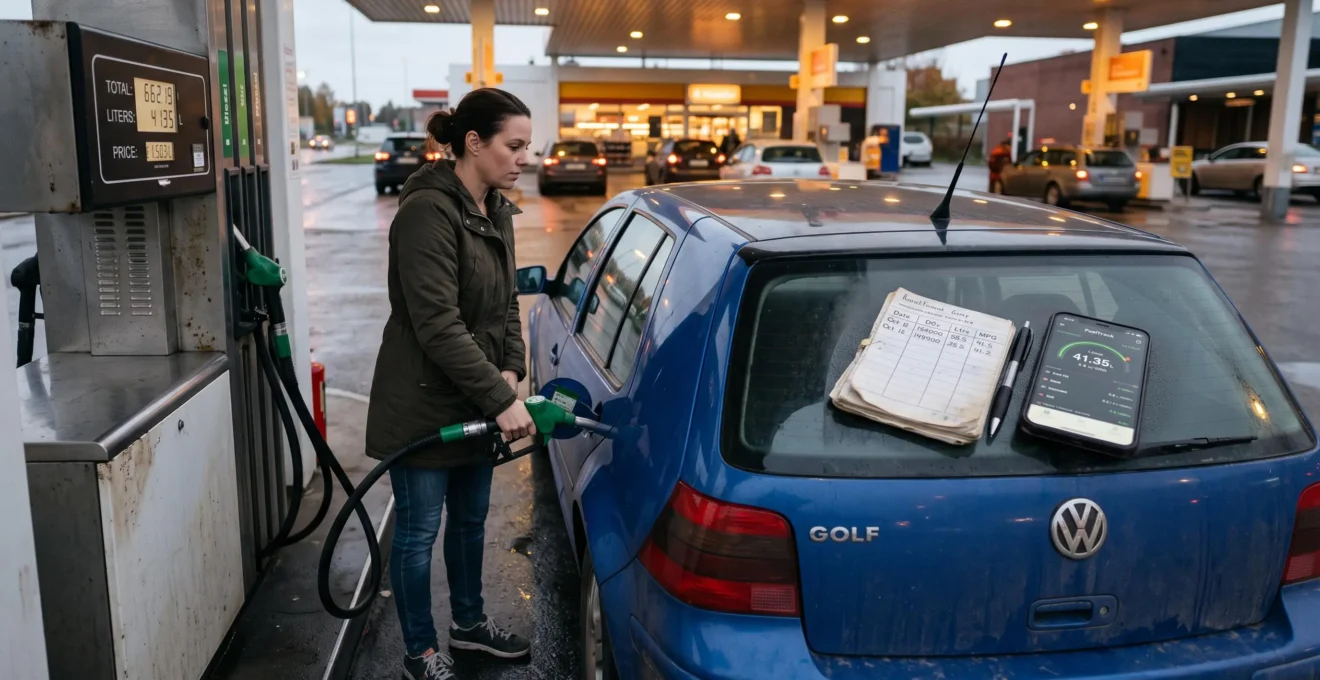
Fuel consumption changes because the amount of energy your car needs is never completely constant. Cold weather, short journeys, traffic, motorway speed, tyre pressure and vehicle load can all affect how much petrol or diesel you burn. Sometimes the variation is entirely normal. In other cases, rising consumption is the first indication of a mechanical problem.
The important distinction is whether your car is using more fuel because its operating conditions have changed or because something is preventing it from working efficiently. A higher reading after a week of short winter journeys does not mean the same thing as a sustained increase on your regular motorway commute.
Identifying the cause starts with reliable measurements and comparable driving conditions, not replacing sensors or engine components on suspicion. Once you understand the difference between unavoidable energy demands and avoidable losses, you can decide whether to adjust your driving, perform basic maintenance or investigate a potential fault.
Fuel consumption changes: the essentials
- Normal variation: Cold starts, traffic, speed, seasonal conditions and vehicle load can change fuel use without indicating a fault.
- Avoidable waste: Incorrect tyre pressure, unnecessary idling, aerodynamic accessories and some mechanical defects make the car consume more than necessary.
- Reliable diagnosis: Compare several full-tank measurements under similar conditions before investigating sensors, engine management or mechanical resistance.
- Why Does Fuel Consumption Rise in Cold Weather and on Short Trips?
- How Can You Find the Cause of Rising Fuel Consumption Without Replacing Parts at Random?
- City or Motorway Driving: Which Uses More Fuel for Your Type of Car?
- Which Hidden Faults Can Raise Fuel Consumption Before Any Other Symptom Appears?
- When Should You Measure Fuel Consumption to Get a Reliable Result?
- Which Engine Faults Can Quietly Increase Energy Waste and Fuel Use?
- Why Does Fuel Economy Drop So Sharply on Short Journeys?
- How Does the Air-Fuel Mixture Affect Engine Performance and Fuel Economy?
Why Does Fuel Consumption Rise in Cold Weather and on Short Trips?
Fuel consumption rises in cold weather because engines and driveline components operate less efficiently before reaching their normal temperatures. Cold oil creates additional friction, petrol engines may require extra fuel during warm-up, and short journeys concentrate these losses into relatively few kilometres. The effect is often normal, especially when winter driving includes frequent cold starts.
When a petrol engine starts cold, fuel vaporises less readily and the engine management system may command a richer air-fuel mixture to maintain stable combustion. As the engine and exhaust system warm up, fuelling and friction losses generally move towards normal operating conditions.
Winter also affects the rest of the vehicle. Tyre pressure can fall as temperatures drop, increasing rolling resistance if inflation is not corrected. Cold air creates greater aerodynamic resistance, while heating, demisting and other electrical demands may add to energy consumption.
15%–33%
Estimated reduction in fuel economy for conventional petrol vehicles on short journeys in cold conditions, according to U.S. government guidance. These figures describe lower fuel economy, not an identical percentage increase in litres per 100 kilometres. Actual results depend on the vehicle, temperature and driving conditions.
U.S. government’s analysis of cold-weather fuel economy, based on vehicle testing and analysis by Oak Ridge National Laboratory.
A journey lasting only a few minutes may end before the engine and its fluids have fully warmed. The exact time depends on outside temperature, engine design and driving conditions, so a ten-minute journey is not a universal dividing line between inefficient and efficient operation.
Prolonged idling is rarely an effective solution. For most modern vehicles, manufacturers generally recommend driving away gently after a brief start-up period rather than leaving the engine running for several minutes. Windows must still be adequately cleared before moving, and manufacturer-specific instructions take priority.
For meaningful comparisons, measure winter consumption against similar winter journeys, ideally from a previous year. A summer-to-winter difference is expected; a persistent increase under comparable winter conditions deserves closer attention.
Weather provides useful context, but it cannot explain every increase. When consumption remains unusually high under comparable conditions, the next step is to investigate systematically rather than assume that winter is responsible.
How Can You Find the Cause of Rising Fuel Consumption Without Replacing Parts at Random?
To identify rising fuel consumption, confirm that the increase is real, eliminate changes in driving conditions and inspect basic maintenance items before testing engine components. Fault codes and live diagnostic readings can then narrow the search. Replacing an oxygen sensor, thermostat or injector without supporting evidence often wastes money and may leave the actual problem unresolved.
Start with the simplest explanation: has anything changed? A different commute, heavier traffic, more passengers, additional luggage or a roof box can increase consumption even when the car is working correctly.
Next, check tyre pressures against the vehicle manufacturer’s recommendations, allowing for load and the specified cold-tyre conditions. Confirm that the engine oil meets the required specification and inspect maintenance records for overdue work. An air filter should be assessed for restriction or damage rather than replaced automatically because fuel consumption has increased.
Modern engine management systems provide more useful evidence than guesswork. A compatible OBD-II diagnostic reader may reveal stored fault codes, coolant-temperature readings and fuel-trim information. Fuel trims show how the engine control unit is adjusting commanded fuel delivery in response to feedback.
Long-term fuel trim is particularly useful when interpreted correctly. A positive correction generally means the ECU is adding fuel relative to its calculated baseline; a negative correction generally means it is removing fuel. Neither reading identifies a faulty component on its own. Engine operating mode, short-term corrections, sensor readings and manufacturer specifications all matter.
The pattern of the increase also helps. Gradual deterioration may accompany declining tyre pressure, changing maintenance condition or repeated short-trip use. An abrupt increase may suggest a discrete fault, such as a dragging brake or thermostat problem, but sudden changes in weather or route can produce a similar pattern.
Five checks before paying for replacement parts
- Establish your baseline: Record fuel purchased and distance travelled across at least three consecutive full-tank intervals. Deliverable: a dated fuel-consumption log.
- Document driving conditions: Note temperature, route type, traffic, typical journey length and added loads. Deliverable: a list of conditions accompanying each measurement.
- Inspect basic maintenance: Check cold tyre pressures, oil specification, air-filter condition and service history. Deliverable: a checklist of confirmed conditions and anything requiring attention.
- Read diagnostic information: If compatible equipment is available, record stored fault codes, coolant temperature and relevant fuel-trim readings. Deliverable: a saved diagnostic report or scan record.
- Verify the suspected cause: Match the evidence to manufacturer-specific test procedures or obtain a professional inspection before authorising repairs. Deliverable: a documented diagnosis and proposed corrective action.
Do not confuse the dashboard’s instantaneous consumption reading with a tank-based average. Instantaneous readings are useful for observing acceleration and driving behaviour, while full-tank records provide an independent measure over longer distances.
Once the measurement and basic condition checks are reliable, driving environment becomes the next major variable. A car can consume very different amounts of fuel in urban traffic and on an open motorway without developing any fault.
City or Motorway Driving: Which Uses More Fuel for Your Type of Car?
City driving generally uses more fuel in conventional petrol and diesel cars because frequent acceleration, braking and idling waste energy. Motorway driving is often more efficient at steady, moderate speeds, although aerodynamic resistance makes high-speed travel increasingly expensive. Full hybrids can behave differently because regenerative braking and engine shut-off reduce some of the penalties associated with urban traffic.
The difference is not simply about road classification. It depends on how the powertrain responds to changing speeds, how often the engine starts from cold and how much resistance the vehicle must overcome.
A conventional combustion-engine car repeatedly accelerates its mass in city traffic. Much of that kinetic energy is lost through braking. At steady motorway speed, the engine can operate under more consistent conditions, although sustained aerodynamic drag becomes increasingly important.
A full hybrid can recover some braking energy and reduce engine operation during stops or low-speed driving. This can make city fuel economy better than motorway fuel economy for certain models. A conventional small petrol car does not automatically share this advantage.
The EPA‘s explanation of real-world fuel economy identifies speed, driving style, traffic conditions and vehicle load as major influences, while highlighting the distinctive urban advantages of hybrid powertrains.
The following comparison shows typical tendencies, not guaranteed results for every model.
| Vehicle type | City driving | Motorway driving |
|---|---|---|
| Conventional petrol | Frequent starts, braking and idling tend to increase consumption. | Steady moderate speeds often improve economy; high speeds increase drag losses. |
| Conventional diesel | Congestion, repeated acceleration and short cold journeys can be inefficient. | Consistent cruising can be efficient, depending on gearing, speed and engine load. |
| Full hybrid | Regenerative braking and reduced engine idling can improve efficiency. | Benefits from steady cruising but may have fewer opportunities for energy recovery. |
At motorway speeds, aerodynamic drag rises approximately with the square of relative air speed. The power required to overcome that drag increases even more rapidly as speed rises. Consequently, a motorway journey at a moderate speed can be economical while the same journey at a much higher speed consumes substantially more fuel. There is no single ideal speed for every vehicle.
For a fair comparison, use the manufacturer’s relevant city, highway or combined figures as broad reference points, while remembering that laboratory tests do not reproduce every real-world condition. Differences in regional testing procedures also mean figures should be compared on the same basis.
If your car mainly operates in congested urban traffic, smoother acceleration, reduced unnecessary idling and better trip planning may make a noticeable difference. On the motorway, speed control, tyre condition and removing unnecessary roof-mounted accessories are particularly relevant.
A change in driving environment can therefore explain substantial variation. When the same car begins consuming more fuel on essentially the same route, however, hidden mechanical resistance or engine-management faults become more plausible.
Which Hidden Faults Can Raise Fuel Consumption Before Any Other Symptom Appears?
Several faults can increase fuel consumption before a driver notices poor performance or a warning light. Possible causes include a thermostat stuck open, inaccurate engine sensors, underinflated tyres, a dragging brake and certain ignition or intake problems. These faults either disrupt fuel control or force the engine to produce more energy than normal.
Because the symptoms can be subtle, the most effective approach is to connect changes in fuel use with specific observations rather than assume that every inefficient car has a sensor fault.
Common possibilities include:
- Thermostat stuck open: The engine may warm up unusually slowly or operate below its intended temperature, increasing friction and potentially affecting fuelling behaviour.
- Coolant-temperature sensor fault: An inaccurate cold reading can lead some engine-management systems to command unnecessary fuel enrichment.
- Dragging brake: A sticking caliper or parking-brake mechanism creates resistance even when the driver is not braking.
- Underinflated tyres: Increased tyre deformation raises rolling resistance and the energy required to move the vehicle.
- Oxygen-sensor deterioration: Incorrect feedback can cause inappropriate fuel corrections, although the effect depends on the sensor and failure mode.
- Restricted air filter: Severe restriction can affect performance and efficiency, but a mildly dirty filter does not necessarily cause a significant fuel-economy loss in a modern electronically controlled engine.
The diagnostic clues differ. An engine that takes noticeably longer to warm up points towards its cooling system or temperature measurements. A car that pulls to one side, feels unusually resistant or develops a hot-brake smell may have a braking problem. A fuel smell or sooty exhaust may suggest a mixture or fuel-system issue.
Do not touch a recently driven wheel or brake assembly to investigate suspected overheating. Brakes can remain dangerously hot. If dragging, smoke or significant heat is suspected, stop safely and arrange professional inspection.
A useful complication is that a fault may exist without illuminating the check-engine light. Some failures remain below diagnostic thresholds; others can leave pending or stored codes. Conversely, an illuminated warning light does not automatically mean the car is running rich.
According to AA1Car’s technical explanation of poor fuel economy, coolant-temperature problems, oxygen-sensor behaviour, misfires and mechanical drag are among the conditions worth assessing through targeted checks and scan-tool readings.
Engine age alone is not a satisfactory diagnosis. Components do wear, but a rising consumption trend should first be checked against maintenance condition, driving circumstances and identifiable faults. The cause may be inexpensive to correct, although that should never be assumed before testing.
A suspected fault is easier to assess when supported by accurate consumption records. The next challenge is deciding when those records are representative enough to justify further investigation.
When Should You Measure Fuel Consumption to Get a Reliable Result?
Measure fuel consumption across several consecutive tankfuls that represent your usual driving, preferably with comparable routes, loads and weather conditions. Fill the tank consistently, record fuel added and distance travelled, and calculate the average consumption. A single journey or refill can be misleading because driving conditions and differences in fill level introduce variability.
A practical method is to start with a full tank, reset the trip odometer and drive normally. At the next refill, fill to a consistent level and record the fuel quantity and distance. Continue the same process for at least three consecutive refill intervals to see whether the apparent increase persists.
The government’s official fuel-economy calculation instructions describe measuring distance between complete refills and dividing it by the fuel used. The same principle works with both imperial and metric records, provided the units are consistent.
Two common calculations are:
- Litres per 100 km: (Litres refilled ÷ kilometres travelled) × 100. Lower values indicate less fuel used per unit of distance.
- US miles per gallon: Miles travelled ÷ US gallons refilled. Higher values indicate better fuel economy. Imperial gallons used in some markets are larger than US gallons, so the two MPG scales must not be mixed.
Hypothetical example: calculating consumption correctly
Suppose a driver travels 450 kilometres between two complete refills and adds 31.5 litres at the second refill. The calculated consumption is (31.5 ÷ 450) × 100 = 7.0 L/100 km.
If the dashboard displays 6.7 L/100 km for that interval, the difference is 0.3 L/100 km. This hypothetical discrepancy is a reason to check the display against further refill records, not proof that the trip computer is defective.
Consistency matters more than achieving a perfectly identical pump shutoff each time. Using the same filling approach, such as stopping at the first automatic nozzle click, can help reduce variation. Avoid overfilling or repeatedly topping off after the nozzle stops, and follow the vehicle’s refuelling instructions.
It is equally important to record context. A tank consumed during unusually cold weather, a long journey with a roof box or a week of exceptional congestion should not be treated as the car’s permanent baseline.
Dashboard averages remain useful for monitoring trends and changing driving habits, but they are estimates generated from vehicle data. A comparison with refill-based calculations helps establish how closely the two methods agree for your car.
Three refill intervals are a practical starting point, not a scientifically guaranteed sample size. If the results fluctuate widely, gather more data. A sustained increase under comparable conditions deserves further investigation, while a stable figure consistent with the car’s normal use is generally reassuring.
Reliable measurements establish whether energy use has changed. Understanding where the additional energy goes helps distinguish an engine-control problem from friction, drag or other external losses.
Which Engine Faults Can Quietly Increase Energy Waste and Fuel Use?
Engine-related faults can waste fuel by causing inefficient combustion, incorrect fuel delivery or increased resistance. Sensor errors, ignition problems and injector faults can alter the combustion process directly. Incorrect oil specification, restricted components and mechanical drag can increase the work required to move the car. Separating these mechanisms helps make troubleshooting more precise.
A useful starting point is to distinguish between fuel-control faults and energy losses. Both can increase the amount of fuel purchased, but they require different diagnostic methods.
| Diagnostic criterion | Direct combustion or fuel-control fault | Indirect energy loss |
|---|---|---|
| Typical causes | Incorrect sensor feedback, ignition misfire, injector or fuel-pressure problem | Dragging brakes, underinflated tyres, excessive aerodynamic drag, unsuitable oil viscosity |
| Main mechanism | Fuel delivery or combustion becomes less efficient | The vehicle requires additional energy to overcome resistance |
| Useful evidence | Fault codes, fuel trims, misfire data and component tests | Pressure checks, brake inspection, service records and vehicle configuration |
| Diagnostic priority | Verify the affected control system before replacing parts | Identify the source of additional resistance or friction |
An oxygen sensor or mass air flow sensor that reports inaccurate information can distort the ECU’s estimate of how much fuel the engine needs. Depending on the fault, the ECU may add fuel unnecessarily, remove fuel in compensation or trigger a different operating strategy.
Ignition faults create another pathway to waste. A misfiring cylinder may receive fuel without converting it efficiently into mechanical work. Some misfires produce noticeable shaking or reduced acceleration; others initially appear only as slightly poorer economy.
Mechanical losses should not be overlooked. Incorrectly high oil viscosity may increase friction, particularly during cold operation. A dragging brake continuously converts vehicle energy into heat. Low tyre pressure increases rolling resistance even when the engine itself is functioning normally.
This leads to an energy-waste audit: look for unnecessary heat, friction, repeated acceleration and aerodynamic resistance before assuming a sophisticated electronic failure. A modest increase can result from several small changes acting together rather than one defective component.
There are also consequences beyond fuel cost. A persistent excessively rich mixture can increase emissions, contaminate spark plugs and potentially damage the catalytic converter. Misfires can be especially harmful if unburned fuel reaches the exhaust system.
A flashing engine warning light or severe misfire requires immediate attention according to the vehicle manufacturer’s instructions; continuing to drive may cause further damage. Fuel smells, visible leaks and abnormal brake overheating also warrant prompt inspection rather than routine fuel-economy monitoring.
Not every apparent energy loss comes from deterioration. Short journeys can expose an otherwise healthy engine to repeated warm-up losses, making the driving pattern itself the main explanation.
Why Does Fuel Economy Drop So Sharply on Short Journeys?
Fuel economy drops sharply on short journeys because a large proportion of the trip occurs before the engine reaches efficient operating conditions. Cold-start fuelling, increased friction and repeated acceleration can dominate consumption over a small distance. A consistently high reading on short trips can therefore be normal, even when the same car performs efficiently on longer journeys.
The essential issue is how much useful distance the engine covers after warming up. During a long journey, the initial warm-up penalty is spread across many kilometres. During a very short journey, that penalty may represent a substantial part of the total fuel consumed.
A cold petrol engine may need additional fuelling to maintain stable combustion, while engine oil and other fluids create more resistance until they warm. In winter, the warm-up phase can last longer, making frequent short journeys especially inefficient.
However, published fuel-economy figures are not necessarily based on an engine that starts fully warm. Official test cycles vary by jurisdiction and can include cold-start operation. Their results simply may not reflect a driver’s particular combination of very short trips, low temperatures and congestion.
The distinction between high consumption per kilometre and high total fuel consumption is important. A short journey can have a poor L/100 km result while still using fewer litres overall than a much longer trip. Extremely high instantaneous readings at low speed also do not represent the consumption of an entire journey.
To establish whether the pattern is normal, compare similar short journeys with one another and then examine fuel use on a longer trip after the engine has warmed. If longer-trip efficiency remains consistent with previous records, the short-trip penalty becomes a more plausible explanation than a hidden engine fault.
There are practical ways to reduce the losses:
- Combine several nearby errands into one trip where practical, reducing repeated cold starts.
- Avoid unnecessary warm-up idling and drive gently once the car is ready to move safely.
- Use walking or cycling for suitable short journeys when the route, weather and personal circumstances allow.
- Maintain the correct tyre pressures and service specifications to avoid adding unnecessary resistance.
For a trip made solely to cover a very short distance, the decision is not just about the consumption display. The total fuel used, time required and available alternatives matter more than the apparent efficiency of that individual journey.
When consumption also increases during longer, comparable journeys, the focus should move beyond trip length. Engine fuelling and the air-fuel mixture are then important areas to assess, alongside mechanical resistance and other driving conditions.
Key takeaways before checking the engine mixture
- A persistent rise across comparable longer journeys is more informative diagnostically than one unusually inefficient cold start.
- Fuel-trim readings describe ECU corrections; their direction and operating conditions matter more than a single isolated value.
- Mixture-related symptoms can narrow the search, but identifying a defective sensor or injector requires corroborating tests.
How Does the Air-Fuel Mixture Affect Engine Performance and Fuel Economy?
The air-fuel mixture determines how effectively a petrol engine burns fuel and produces power. An excessively rich mixture can waste fuel, increase emissions and contaminate engine components. An excessively lean mixture may cause hesitation, misfires or excessive combustion temperatures under certain conditions. The ECU adjusts fuelling using sensor feedback, operating conditions and engine-management strategies.
In a conventional petrol engine, the chemically balanced, or stoichiometric, air-fuel ratio is approximately 14.7 parts air to one part petrol by mass, although the exact value depends on fuel composition. This ratio is important for normal three-way catalytic-converter operation, but engines do not necessarily use it under every condition.
During cold starts, heavy acceleration or other operating modes, the ECU may intentionally command a different mixture. Some modern engines also use specialised combustion strategies. A mixture that differs from stoichiometric is therefore not automatically a fault.
Rich running means there is more fuel relative to the available air than the target mixture requires. Possible signs include a fuel smell, excessive soot, fouled spark plugs and higher consumption. Not every rich-running problem produces visible exhaust smoke, and a fuel smell should never be dismissed as a harmless economy issue.
Lean running means there is less fuel relative to the air than intended. Possible symptoms include hesitation, rough idling, misfires or reduced power. Lean operation does not always reduce fuel consumption: the driver may compensate with greater throttle input, and unstable combustion can waste fuel despite the lower fuel quantity in an individual combustion event.
The ECU relies on multiple components to manage fuelling. These may include oxygen or air-fuel ratio sensors, mass air flow or manifold pressure sensors, coolant-temperature sensors, injectors and fuel-pressure controls. A fault in one component can create corrections that initially look like a problem elsewhere.
For example, a positive fuel-trim correction can occur when the ECU detects a lean indication and adds fuel. Possible causes include unmetered intake air, inaccurate airflow measurement or insufficient fuel delivery. A negative correction can occur when the ECU removes fuel in response to a rich indication. Neither pattern proves that the oxygen sensor itself is defective.
Cleaning a throttle body or replacing a sensor because the engine appears to be running rich is therefore an unreliable shortcut. A competent diagnosis considers fault codes, live sensor readings, fuel trims under relevant conditions, air leaks and fuel-system tests before identifying the component responsible.
The distinction also prevents an expensive mistake: a fuelling problem that remains unresolved can affect emissions-control components, while unnecessary replacements may introduce additional expense without improving consumption.
Start by recording consumption over several representative tankfuls, then check the driving conditions and simple sources of energy loss. If the increase persists, use compatible diagnostic data and targeted mechanical tests to identify the cause. This approach distinguishes normal fuel-consumption variation from avoidable waste without treating every higher reading as a mechanical failure.
Can fuel consumption increase without a check-engine light?
Yes. Underinflated tyres, additional vehicle load, brake drag and changes in driving conditions can increase fuel use without triggering an engine warning. Some developing engine faults may also remain below diagnostic thresholds or generate stored codes before a warning light appears. A missing warning light does not prove that every component is working correctly.
Does using air conditioning always increase fuel consumption?
Air conditioning requires energy and can increase fuel consumption, especially under demanding cooling conditions. However, the size of the effect depends on the vehicle, compressor operation, weather and speed. Driving with the windows open can also increase aerodynamic drag, particularly at higher speeds. The more efficient option depends on the circumstances rather than a universal rule.
Should fuel consumption be compared in MPG or L/100 km?
Either measurement works if it is used consistently. MPG expresses distance travelled per unit of fuel, so higher figures indicate better economy. L/100 km expresses fuel consumed over a fixed distance, so lower figures indicate better economy. Always distinguish US gallons from Imperial gallons when comparing MPG values from different countries.
Can a car use more fuel after a service?
Yes, although the service itself should not automatically be blamed. Check whether tyre pressures, oil specification, vehicle settings, driving conditions or recorded measurement intervals changed. If the increase is persistent and began immediately after maintenance, ask the workshop to verify the work performed and inspect relevant components instead of assuming that the change is normal.
Is a sudden increase in fuel use more concerning than a gradual one?
A sudden increase deserves attention, particularly if the route, weather and load are unchanged, because it may coincide with a new fault or increased mechanical resistance. However, gradual deterioration can also reflect a significant problem. The rate of change is a diagnostic clue, not a definitive test. Fuel leaks, strong fuel smells, brake overheating or severe engine symptoms require prompt attention regardless of how quickly consumption changed.