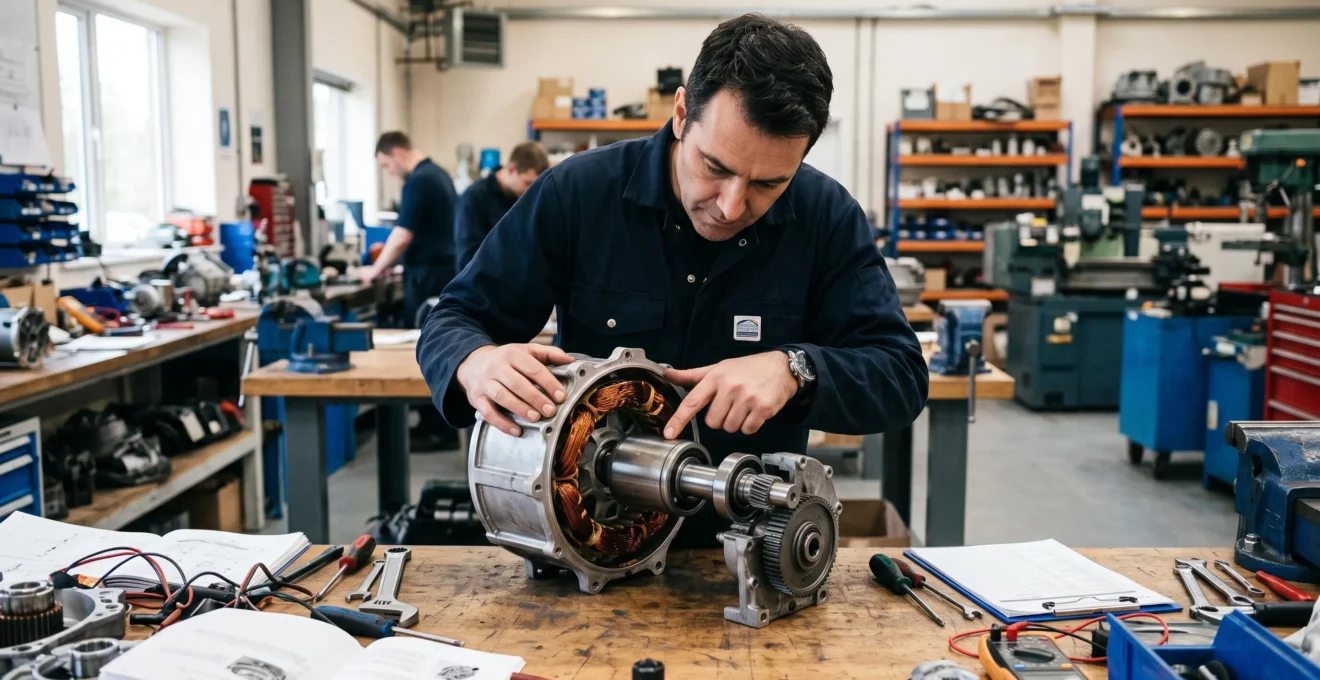
An electric vehicle can accelerate almost immediately after the driver presses the accelerator, without waiting for an engine to build revs or a gearbox to select another ratio. The reason lies in how its electric motor produces rotational force: controlled electromagnetic fields act directly on a rotor, generating torque without combustion, pistons or a conventional multi-speed transmission.
This straightforward conversion of electrical energy into mechanical motion helps explain three defining characteristics of electric propulsion: rapid response, high energy efficiency and relatively low routine maintenance. However, a simple motor does not mean a mechanically or electronically uncomplicated vehicle. The inverter, battery, cooling system, reduction gears and control software all influence performance.
Understanding these components helps drivers interpret acceleration figures, compare motor technologies and recognise when changes in performance deserve attention. It also explains why an EV can feel exceptionally responsive around town while consuming substantially more energy during sustained motorway driving.
Electric motor technology: The essentials
- Electromagnetic forces generate torque directly, allowing strong acceleration from a standstill without the combustion cycles or gear changes associated with conventional engines.
- Electric drivetrains are highly efficient, but actual energy consumption depends on speed, temperature, regenerative braking and the entire vehicle’s design.
- Fewer mechanical wear components generally reduce scheduled maintenance, although bearings, cooling systems, electronics and high-voltage components still require attention when symptoms appear.
- Why Do Electric Motors Deliver Maximum Torque So Quickly?
- How Does Electric Motor Efficiency Change During City and Motorway Driving?
- Permanent-Magnet or Induction Motor: Which Better Suits Different EV Uses?
- Which Electric Motor Problems Can Reduce EV Performance Without Immediate Failure?
- When Does an Electric Motor Need Professional Inspection?
- Why Can a High-Torque Engine Feel Fast Without Huge Horsepower?
- City or Motorway Driving: Which Vehicle Features Matter Most for Energy Efficiency?
- What Determines Real-World Driving Range in Different Conditions?
Why Do Electric Motors Deliver Maximum Torque So Quickly?
Electric motors can produce strong torque almost immediately because electromagnetic forces act directly between the stationary stator and rotating rotor. Unlike combustion engines, they do not need repeated fuel-burning cycles to generate force. Many EV traction motors provide their maximum available torque from standstill through a low-speed operating range, although output remains subject to electronic and electrical limits.
The stator contains windings that create a controlled magnetic field. That field interacts with the rotor, producing the turning force that drives the wheels through a reduction gear. The exact interaction differs between permanent-magnet and induction motors, but both avoid the reciprocating pistons, crankshaft mechanisms and combustion cycles required by conventional engines.
A petrol or diesel engine develops its strongest torque within a particular engine-speed range. Air intake, fuel combustion, mechanical friction and transmission gearing influence how quickly usable force reaches the wheels. An electric motor instead generates torque as soon as the control system supplies the appropriate current. This is the physical basis of the EV’s immediate accelerator response.
The inverter and motor controller determine how much of that torque is actually delivered. By rapidly adjusting the electrical current and magnetic field, the system can regulate acceleration with fine precision. Available torque may nevertheless be restricted by battery output, inverter capacity, traction, temperature and component protection settings.
Repeated hard launches can increase component temperatures and battery demands. If a protection threshold is approached, the vehicle may temporarily reduce power. This behaviour is known as power derating and does not necessarily indicate a mechanical failure.
Fewer moving parts also need context. Although the motor avoids many combustion-engine components, the complete drive unit still includes a rotor shaft, bearings, reduction gears, seals and, depending on its design, pumps and cooling equipment. These components affect reliability and how smoothly torque reaches the wheels.
Instant response explains why EVs feel energetic at low speeds. Sustaining that performance efficiently, however, depends on where and how the vehicle is driven.
How Does Electric Motor Efficiency Change During City and Motorway Driving?
Electric motors generally operate efficiently across a broad range of speeds and loads, but vehicle energy consumption changes substantially between city streets and motorways. Urban driving benefits from regenerative braking and minimal propulsion energy use while stationary. At higher speeds, aerodynamic resistance increases sharply, raising energy demand even when the motor itself remains efficient.
The distinction is between motor efficiency and overall vehicle efficiency. A motor converts electrical energy into mechanical output, but energy is also lost in the inverter, wiring, battery, transmission and auxiliary systems. Heating and cooling add further consumption that is not captured by the motor’s standalone efficiency figure.
The U.S. government electric vehicle energy-flow analysis illustrates this distinction. It estimates electric-drive system losses of approximately 15% to 20% in its representative energy accounting. Those figures describe a drive system rather than every possible operating point of an individual motor, and the estimates draw primarily on older vehicle testing.
City driving creates repeated opportunities for regenerative braking. During deceleration, the motor operates as a generator, converting some vehicle motion back into electrical energy for storage in the battery. This reduces energy otherwise dissipated through friction brakes.
32% versus 6%
Illustrative regenerative-braking energy recovery figures in the U.S. government analysis: approximately 32% for its city driving cycle and 6% for its highway cycle. These are cycle-specific energy-accounting values, not universal percentages of battery capacity recovered or standalone motor efficiency.
U.S. Department of Energy and Environmental Protection Agency, Where the Energy Goes: Electric Cars.
Regeneration has limits. A nearly full or cold battery may be unable to accept much recovered energy, so the vehicle can reduce regenerative braking. Friction brakes then provide more of the required deceleration. On motorways, braking opportunities are less frequent, while the energy required to overcome air resistance continues to increase with speed.
For a meaningful comparison, drivers should record consumption in kWh/100 km or kWh/100 miles using their trip computer. Compare representative city and motorway journeys, noting temperature, traffic, elevation and average speed. Lower consumption per distance indicates more efficient operation under those particular conditions.
The resulting difference in consumption also depends on motor architecture. Permanent-magnet and induction technologies achieve similar driving objectives through different electrical and magnetic designs.
Permanent-Magnet or Induction Motor: Which Better Suits Different EV Uses?
Permanent-magnet motors generally offer high power density and favourable efficiency across many everyday operating conditions. Induction motors generate rotor magnetism electrically rather than using permanent magnets, avoiding dependence on rotor rare-earth magnets. Neither architecture is universally superior: efficiency, operating temperature, cost, control strategy and vehicle requirements determine which is better suited to a particular EV.
In a permanent-magnet motor, magnets embedded in or attached to the rotor create a magnetic field. This can reduce the need to produce rotor magnetism electrically, helping efficiency, especially at certain light-load operating points.
Induction motors work differently. Alternating magnetic fields from the stator induce currents in the rotor, producing the magnetic forces needed for rotation. These rotor currents create additional losses, although efficient modern designs can still perform well over a broad operating range.
The U.S. Department of Energy overview of advanced electric motor technologies identifies high power density as a strength of internal permanent-magnet designs and high starting torque and reliability as characteristics of induction motors. It also highlights the importance of material sourcing and thermal management.
Many high-performance permanent-magnet designs use rare-earth materials such as neodymium, sometimes with dysprosium or terbium. These materials affect manufacturing costs and supply-chain exposure. Induction rotors do not need permanent magnets, offering manufacturers an alternative. However, not all permanent-magnet motors use rare-earth magnets.
Thermal performance requires care when comparing the two. An induction motor avoids permanent-magnet demagnetisation, but rotor heating and insulation limits still matter. Its suitability for sustained high-load operation depends on its particular design and cooling system, not simply the absence of magnets.
The practical differences can be summarised without assuming that one motor type always wins.
| Comparison criterion | Permanent-magnet motor | Induction motor |
|---|---|---|
| Rotor magnetic field | Provided by permanent magnets | Generated through induced electrical currents |
| Everyday efficiency | Often favourable, particularly at lighter loads | Can be highly efficient, with additional rotor-current losses |
| Power density | Often a major design advantage | Depends on configuration and packaging |
| Materials | Some high-performance designs require rare-earth magnets | No rotor permanent magnets required |
| High-temperature operation | Permanent magnets have temperature-dependent limits | No permanent-magnet demagnetisation risk, but other thermal limits remain |
| Best purchasing consideration | Vehicle-level efficiency and usable range | Vehicle-level performance, thermal management and operating behaviour |
Some dual-motor vehicles combine permanent-magnet and induction units to balance efficiency and performance requirements. Depending on the drivetrain, control software may vary the contribution of each axle and minimise the losses associated with a motor that is not needed. The exact strategy is manufacturer- and vehicle-specific; neither motor type is universally assigned to cruising, launching or regeneration.
For buyers, a permanent-magnet design can be attractive when everyday efficiency matters, while an induction design may offer material-sourcing or system-design advantages. Heavy towing, sustained motorway use and hot-weather driving should be evaluated using the vehicle’s tested performance and cooling capabilities rather than motor type alone.
Whichever technology a manufacturer chooses, long-term performance depends on controlling heat, mechanical wear and electrical faults before they disrupt propulsion.
Which Electric Motor Problems Can Reduce EV Performance Without Immediate Failure?
Electric motor problems can reduce performance gradually without immediately disabling a vehicle. Bearing wear, winding insulation deterioration, sensor faults and excessive temperatures can produce noise, vibration, irregular power delivery or reduced acceleration. The control system may also deliberately limit output to protect components, making professional diagnostics essential before attributing symptoms to motor damage.
Bearing wear is one possible mechanical issue. Bearings support the rotor shaft and allow it to rotate smoothly. Wear or lubrication problems may produce an unfamiliar whine, rumble or vibration that changes with road speed or drivetrain load. Similar symptoms can come from reduction gears, tyres or wheel bearings, so sound alone cannot identify the source.
Motor windings and their electrical insulation are exposed to repeated temperature changes and electrical stresses. Sustained overheating can accelerate insulation deterioration. In permanent-magnet motors, severe thermal exposure may also reduce magnetic performance if the magnets exceed their design limits.
Rotor position sensors and related control systems help the inverter deliver electrical current at the appropriate time. Sensor or signal faults can cause irregular torque delivery, warning messages or a restricted operating mode. The exact symptoms depend on how the vehicle manages the fault.
Thermal derating is particularly important because it can feel like mechanical deterioration even when protective systems are working correctly. During a demanding hill climb or repeated acceleration, rising motor, inverter or battery temperatures may trigger a deliberate power reduction. Once conditions return to an acceptable range, normal output may resume.
These symptoms can overlap with battery, inverter and cooling-system problems. Reduced regenerative braking, for example, might reflect a cold or nearly full battery rather than a defective motor. Increased energy consumption could arise from tyres, temperature, road conditions or electrical losses elsewhere in the vehicle.
Diagnostic trouble codes, thermal data and manufacturer-specific measurements help distinguish these possibilities. A useful owner-level response is to record when the behaviour appears, whether it repeats and which dashboard messages accompany it.
When a change persists, becomes more severe or is accompanied by a drivetrain warning, the priority shifts from observation to qualified inspection.
When Does an Electric Motor Need Professional Inspection?
An electric motor or drive unit needs professional inspection when it develops persistent grinding or unusual whining, abnormal vibration, a suspected coolant leak, drivetrain warning messages or sudden and repeatable power loss. These symptoms can originate from several components, but continuing to drive without diagnosis may increase damage or create safety risks.
Battery-electric vehicles generally require less scheduled drivetrain maintenance than combustion vehicles. According to the Alternative Fuels Data Center guidance on EV maintenance and safety, electric motors, batteries and associated electronics typically need little or no routine maintenance. This does not mean that a developing fault should be ignored.
Some warnings require an immediate change of plans. Grinding noises, substantial vibration, visible coolant leakage or severe power loss justify stopping in a safe place and arranging professional advice or recovery. If the vehicle displays an instruction to stop driving, that instruction takes priority.
EV diagnosis goes beyond conventional mechanical checks. Depending on the fault and vehicle design, a qualified technician may need to examine inverter data, interpret manufacturer-specific diagnostic trouble codes, assess sensor calibration or perform insulation resistance measurements using appropriate high-voltage safety procedures.
The high-voltage system is a critical boundary between owner maintenance and professional service. Owners can observe symptoms, review dashboard alerts and perform manufacturer-approved coolant checks where accessible. They should never open a drive unit, probe high-voltage terminals or disconnect orange high-voltage cables without the necessary training and safety equipment.
A documented fault history helps the technician reproduce intermittent problems and can support later discussions about manufacturer warranty coverage. Inspection requirements, service intervals and warranty conditions vary by model, manufacturer and country. A professional inspection does not automatically establish warranty eligibility, but an accurate service record can provide useful evidence.
Five practical steps to prepare for an EV drive-unit inspection
- Record the symptom: Write down the noise, vibration or power change and the circumstances in which it appeared. Deliverable: a dated symptom log.
- Capture dashboard information: Safely photograph warning messages when the vehicle is stationary. Deliverable: a readable record of alerts.
- Review driving conditions: Note relevant factors such as outside temperature, road gradient, recent rapid acceleration and approximate battery charge. Deliverable: a short operating-conditions summary.
- Check manufacturer guidance: Consult the owner’s manual for the warning displayed and the relevant service instructions, without accessing high-voltage components. Deliverable: the applicable manual reference.
- Arrange qualified diagnosis: Provide the observations to an appropriately trained EV service provider and request a written diagnostic report. Deliverable: a record of findings, fault codes and recommended actions.
Preventive observation matters, but a healthy motor’s strongest benefit remains its ability to convert electrical input into responsive acceleration with relatively little mechanical complexity.
Why Can a High-Torque Engine Feel Fast Without Huge Horsepower?
A high-torque powertrain can feel fast because torque produces rotational force that, through the drivetrain, creates the driving force at the tyres. Strong torque at low speeds delivers immediate acceleration even when peak horsepower is modest. Horsepower measures the rate of doing work, so sustained acceleration at higher speeds increasingly depends on available power rather than the peak torque figure alone.
Torque and power are related but describe different characteristics. Torque is measured in newton-metres (Nm) or pound-feet (lb-ft), while power is commonly expressed in kilowatts (kW) or horsepower (hp). Mechanical power increases with the product of torque and rotational speed.
An electric motor may deliver its maximum torque from standstill through a defined low-speed range. As the rotor accelerates beyond that range, torque often decreases as the motor approaches an approximately constant-power operating region. Consequently, strong initial acceleration does not imply that the same acceleration force remains available at every speed.
At the wheels, acceleration also depends on gear reduction, tyre grip and vehicle mass. Two vehicles with identical motor torque figures can accelerate differently because of gearing, traction control, weight and power limits.
Consider an explicitly hypothetical comparison. Vehicle A has an electric motor with a broad low-speed torque plateau but lower peak power. Vehicle B has a combustion engine with greater peak horsepower, although its strongest output arrives at higher engine speeds. Vehicle A might respond more quickly during an ordinary low-speed manoeuvre, while Vehicle B could offer stronger acceleration as speeds increase, depending on their gearing, mass and actual power curves.
The sensation is amplified by the EV’s continuous torque delivery and lack of conventional gear-change interruptions. Accelerator mapping can make a vehicle feel particularly eager, although subjective responsiveness should not be confused with objectively superior acceleration.
Buyers should therefore examine the torque curve and power curve, together with acceleration results over relevant speed intervals. A single maximum torque number cannot describe how a car performs throughout its operating range.
That distinction also leads to a practical efficiency question: which vehicle characteristics matter most when driving conditions shift from urban traffic to open motorways?
City or Motorway Driving: Which Vehicle Features Matter Most for Energy Efficiency?
City driving rewards efficient regenerative braking, sensible vehicle mass, low rolling resistance and effective climate control. Motorway efficiency depends more heavily on aerodynamic drag, sustained speed and rolling resistance. The most economical EV is therefore not necessarily the same for every driver: the best design depends on how much time the vehicle spends in each driving environment.
Urban driving repeatedly changes a vehicle’s kinetic energy through acceleration and braking. A heavier car generally requires more energy to accelerate, although regenerative braking can recover some of that energy during deceleration. Rolling resistance and auxiliary electrical loads also contribute to consumption.
Regenerative braking effectiveness is especially useful where traffic lights, junctions and congestion create frequent deceleration. However, regeneration is not perfectly efficient, and it cannot recover all the energy spent accelerating. Smooth driving that avoids unnecessary speed changes can still improve efficiency.
Low rolling-resistance tyres can reduce energy loss as the tyres deform against the road. The trade-off is that tyre selection must also account for grip, braking performance, wear and noise, rather than efficiency alone.
Heating technology matters in colder climates. A well-designed heat pump can reduce electrical demand for cabin heating under suitable operating conditions compared with direct resistance heating. Its benefit depends on ambient temperature and the vehicle’s thermal-management design.
At motorway speeds, aerodynamic drag becomes increasingly important. Drag force rises approximately with the square of speed under otherwise comparable conditions, while the power needed to overcome it rises approximately with the cube. Vehicle shape, frontal area, underbody design, ride height, wheel design and airflow around mirrors can all influence resistance.
A useful comparison separates the priorities of both environments.
| Vehicle characteristic | City driving | Motorway driving |
|---|---|---|
| Regenerative braking | Important during frequent deceleration | Less useful during sustained cruising |
| Vehicle mass | Influences repeated acceleration demand | Influences rolling resistance and climbing demand |
| Aerodynamic design | Usually less influential at low speeds | Increasingly important as speed rises |
| Low rolling-resistance tyres | Useful for reducing continuous losses | Useful throughout sustained driving |
| Efficient cabin heating | Important during cold, low-speed journeys | Relevant during cold long-distance travel |
Some design choices involve compromises. Larger wheels, wider tyres or a higher body may serve styling, handling, clearance or load requirements while increasing energy use in certain conditions. Conversely, an aerodynamically optimised vehicle may offer its greatest advantage at speeds that an urban driver rarely reaches.
Once the typical driving environment is understood, the next step is to translate these efficiency differences into a realistic expectation of usable range.
Key takeaways for estimating your EV’s range
- Start with the driving conditions that occur most frequently, particularly sustained speed and seasonal temperature.
- Use actual energy consumption rather than assuming that a manufacturer’s combined-cycle rating describes every journey.
- Account for usable battery capacity, vehicle age and an appropriate reserve when planning longer trips.
What Determines Real-World Driving Range in Different Conditions?
Real-world EV range depends on usable battery energy and how much electricity the vehicle consumes per distance travelled. Speed, temperature, terrain, payload, driving style and climate-control demands all influence that consumption. Official ratings provide standardised comparisons, but the distance achievable on a particular journey can be significantly higher or lower.
Range is therefore an output of the complete vehicle system, not a fixed property of the electric motor or battery alone. A highly efficient motor cannot compensate entirely for substantial aerodynamic drag, prolonged climbing or heavy heating demands.
Official testing methods also differ between markets. WLTP ratings are commonly used in the UK and several other markets, while EPA figures are standard in the United States. Ratings produced under different test procedures should not be treated as directly interchangeable.
Cold weather is a particularly important source of variation. Low temperatures can reduce battery performance and regenerative braking capability. At the same time, cabin heating requires energy from the battery, whereas combustion vehicles can make use of waste engine heat.
Approximately 41%
The electric driving range reduction reported in the U.S. government’s cold-weather guidance, based on 2019 AAA testing under specific low-temperature and cabin-heating conditions. This is not a universal winter range loss and should not be assumed for all modern EVs.
U.S. government analysis of cold-weather fuel economy, citing AAA electric vehicle range testing.
Temperature management can help reduce the penalty. Preconditioning the cabin while connected to external power may preserve more battery energy for driving. Heat pumps and targeted seat heating can also improve comfort-related efficiency in suitable conditions, although their effectiveness varies by vehicle.
Battery age introduces another variable. Usable capacity can decline over time as cells experience calendar ageing and charge-discharge cycles. Long-term degradation depends on battery chemistry, temperature exposure, charging patterns and battery-management strategy. Frequent rapid charging or extended time at high charge levels may contribute to degradation under some conditions, but their effects are not identical across vehicles.
The most practical estimation method uses your own measured consumption rather than relying only on a rated range.
For an explicitly hypothetical example, assume an EV has 60 kWh of usable battery capacity and averages 18 kWh/100 km during representative driving. Its calculated full-usable-capacity range would be:
60 ÷ 18 × 100 = approximately 333 km.
This is an illustrative calculation, not a measured result for any particular EV. It excludes a separate reserve and assumes consumption stays at the stated average. For planning, the calculation should use the energy actually available at departure and allow an appropriate arrival reserve.
Drivers can repeat the calculation using consumption recorded over a representative week, separating city and motorway journeys where possible. Updating the figures during colder months, after tyre changes or as the vehicle ages gives a more realistic picture of expected range.
To make better EV purchasing or trip-planning decisions, compare real consumption under your usual conditions, consult the manufacturer’s battery and maintenance guidance, and calculate expected range with a sensible reserve rather than relying on a single advertised figure.
Do electric vehicles need a gearbox?
Most battery-electric passenger vehicles use a fixed-ratio reduction transmission rather than a conventional multi-speed gearbox. Electric motors can produce useful torque over a broad speed range, reducing the need to change ratios. Some EVs use multi-speed transmissions for particular performance or efficiency objectives, so a single-speed system is common but not universal.
Does instant torque mean an EV always accelerates faster than a petrol car?
No. Instant torque provides rapid response, but acceleration also depends on vehicle mass, tyre traction, gearing, available power and electronic restrictions. A petrol car with greater usable wheel power may accelerate faster in some speed ranges, particularly after the EV’s initial torque advantage decreases.
Can regenerative braking completely replace conventional brakes?
No. Regenerative braking recovers some kinetic energy during deceleration, but friction brakes remain necessary for adequate stopping performance, low-speed operation and circumstances where regeneration is restricted. Battery temperature, charge level, traction and vehicle control settings can all limit regenerative braking.
Do electric motors require regular oil changes?
Electric traction motors do not require combustion-engine oil changes. However, some drive units contain lubricated reduction gears or other components with manufacturer-specific fluid requirements. Owners should follow the vehicle’s maintenance schedule rather than assume that every electric drivetrain is completely fluid-free.
Can an EV’s motor remain healthy even if driving range decreases?
Yes. Range can decrease because of colder weather, higher motorway speeds, cabin heating, tyre conditions, battery ageing or changes in driving patterns, even when the motor operates normally. A consistent range decline accompanied by abnormal drivetrain noise, warning messages or unusual power restrictions warrants professional investigation.